There is little guarantee that a dietary supplement will actually contain what is advertised on the packaging and not have undeclared contaminants.
In one of my videos a few years ago, I talked about how press releases on the latest science coming out of even top medical centers were filled with overstatements and omissions. Medical journal press releases suffered from similar problems, and press releases from the drug companies were no different, filled with hype and exaggeration. What about press releases issued by the supplement industry? (I’m not even talking about supplement manufacturers, but trade organizations representing the multibillion-dollar dietary supplement industry.)
Researchers found that 100% of supplement industry press releases contained “spin,” meaning “strategies to hype or denigrate findings” to distort clinical studies’ results. Here’s the wild part: Industry press releases advocated for supplement use in response to more than 90% of studies reporting no benefit or harm. Let’s say a study is published showing a supplement may actually be harmful. The vast majority of independent institutions like the National Institutes of Health and mainstream media reports would likely warn people to avoid it. But most industry trade organizations would essentially say, Harm? Go for it! Buy an extra bottle. The numbers are illustrated below and at 1:24 in my video Supplementation Regulation and Side Effects: Efforts to Suppress the Truth.
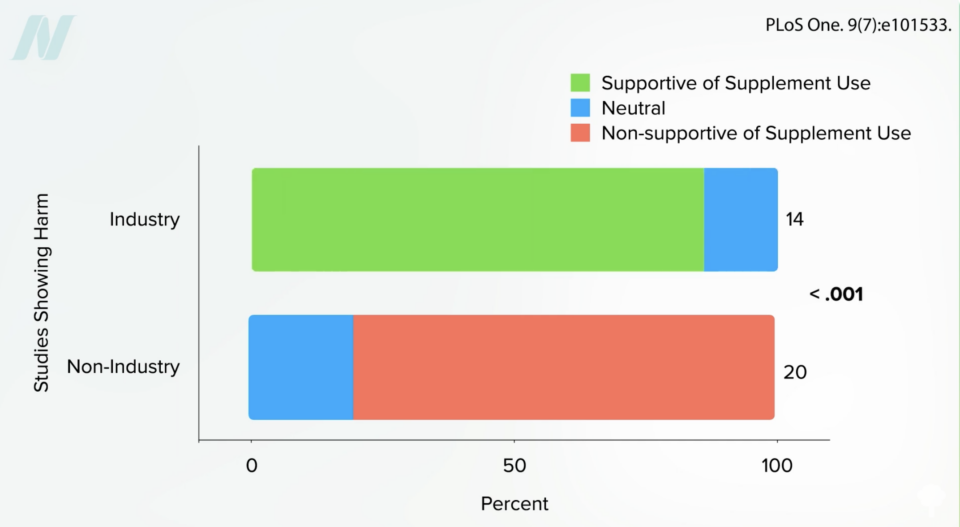
“It is therefore likely that the propagation of the ‘spin’-enriched industry press releases contributes to the ongoing, and even burgeoning, enthusiasm for use of supplements in the face of accumulating evidence of their ineffectiveness and, in some cases, harm.” Indeed, in some cases, people are paying to make themselves sick. Sadly, the science may not even matter to many supplement users. Most dietary supplement users said they would be “minimally influenced” by independent, taxpayer-funded studies that contradict the supplement manufacturers’ efficacy claims. Only about one-fourth of users said they would stop taking a supplement if public health authorities stated that it was just a waste of money.
The “snake oil salesman” wasn’t just a stereotype. He was actually a real person: Clark “the Rattlesnake King” Stanley. In 1916, it was discovered that Stanley’s snake oil, in fact, contained no snake oil at all—it was basically spicy moth repellent mixed with turpentine. Prosecuted under the newly enacted Pure Food and Drug Act, he was ultimately fined a lofty sum of $20. A century later, here we are with snake oil coming out of our ears—there’s a vast number of supplements marketed and sold without routine oversight. Now, the supplement industry bristles at such talk, saying that the industry is regulated to protect consumers. It’s true there are definitely laws on the books, but “[t]he ability of regulators to successfully carry out this mission, however, is hampered by the sheer number of products.”
The U.S. Food and Drug Administration (FDA) estimates more than 85,000 dietary supplement products are currently available in the United States alone. The sheer number of products, combined with the underreporting of adverse side effects, the difficulty of successfully prosecuting offenders, and the ease with which suppliers can rebrand products removed from shelves, has created a largely unregulated environment. “In the real world, there is little guarantee that a supplement will even contain what is advertised on the packaging and not contain unlisted ingredients, potentially leading to significant harms,” resulting in an estimated 23,000 emergency room visits every year. Now, of course, prescription drugs don’t just sicken but kill many more, making them perhaps the third leading cause of death, wiping out more than 100,000 Americans each year, but still, the less death and disability, the better.
Dietary supplements are often adulterated with undeclared pharmaceuticals—most often found in supplements for erectile dysfunction, weight loss, diabetes, and high blood pressure—which could represent “an enormous risk to consumers.” But what about supplement manufacturers that say they have independent, third party–certification of purity? There is a practice called “dry labbing,” a dirty little secret in the supplement industry, where quality assurance labs just rubber-stamp fake documents. And if you think that’s outrageous, check out the story of β-methylphenylethylamine (BMPEA).
A researcher at Harvard published a paper replicating prior research from the FDA detecting a designer amphetamine-like stimulant, BMPEA, in various supplements sold in the United States. In response, one of the offenders, Hi-Tech Pharmaceuticals, which manufactures weight-loss supplements like Black Widow and Yellow Scorpion, sued the researcher for libel, slander, and product disparagement, originally seeking $200 million in damages.
This was all documented in a piece by STAT, which is an excellent source of medical journalism that I recommend. The head of Hi-Tech “openly admitted that he was ‘hoping that we were able to silence this guy.’” Although ultimately unsuccessful in court, the lawsuit effectively sent a warning to other researchers. In fact, Hi-Tech’s CEO is reported to have said that he “hope[s] that the long and costly legal battle will scare away other academics from investigating the supplement industry.”
Doctor’s Note
The video I mentioned is Spin Doctors: How the Media Reports on Medicine.
I’ve covered the shady and unregulated nature of the supplement industry before. Check out:
STAT is the medical journalism site I referred to. You can see it here.
from NutritionFacts.org https://nutritionfacts.org/blog/are-supplements-the-new-snake-oil/
via IFTTT