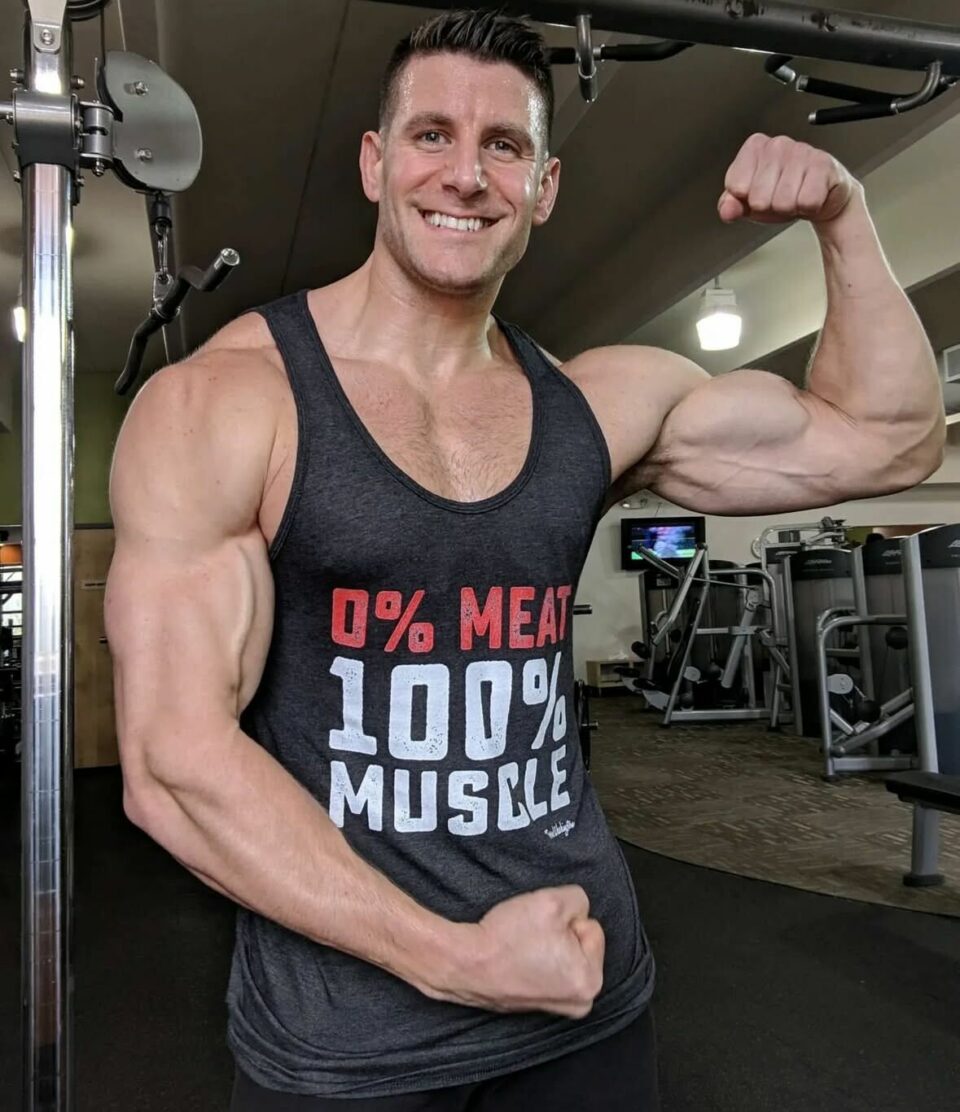
Celebrating Veterans Day with Ronnie Penn

We had the pleasure of talking with Ronnie Penn about his military service, his work as a chef and a coach, and what Veterans Day means to him. We hope you enjoy this interview. 


Thank you for your service, Ronnie. We’re honored to speak with you today. Can you start by sharing a bit about your background? What inspired you to enlist, and when did your military journey begin?

I grew up wanting to serve something bigger than myself, and the Marine Corps gave me that opportunity. I enlisted in 2004 and deployed to Iraq during Operation Iraqi Freedom and to Afghanistan from 2012 to 2014. Later, I served in the Coast Guard as a chef, which opened a whole new chapter in how I looked deeper into nutrition. Service taught me discipline, resilience, and the importance of teamwork—qualities I carry into everything I do today.


How did your time in the military shape who you are today? Is there anything in particular about your service that you would like to share?

The military taught me to stay calm under pressure and adapt quickly. Whether it was on deployment overseas or working with my shipmates in the galley, I learned how much impact food, mindset, and discipline can have on performance and morale. Those lessons shaped who I am now—not only as a veteran, but also as a coach who helps others take control of their health.


Were there any habits or disciplines from your military experience that helped in your transition to plant-based living or in your work today as a coach?

Two habits stuck with me: structure and accountability. In the Marines, every detail mattered. That same mindset helps me stick to meal prep, training schedules, and coaching clients. It also made the transition to plant-based eating easier because I was already used to planning ahead and being intentional about what I put into my body.


You’ve spoken about health issues that arose during competition prep, which ultimately led you to switch to a plant-based diet. What symptoms were you experiencing at the time, and what physical or medical changes did you notice after the transition?

When I was competing in bodybuilding, I pushed my body hard—lots of animal protein, supplements, and restrictive dieting. Over time, I developed digestive issues and constant fatigue. Switching to a whole food, plant-based diet changed everything. My digestion improved, and my energy came back. It was eye-opening to see how quickly the body can heal when you give it the right fuel.


Did you encounter any challenges accessing or preparing plant-based foods during active service? How did you make it work in that environment?

Back then, plant-based options were limited, especially on deployment. I loaded up on oatmeal, beans, rice, fruits, and vegetables whenever I could, and I had to get creative, too. I learned how to make simple meals with what was available, and that creativity carried into my role as a chef in the Coast Guard.


Were there any particularly memorable reactions from your shipmates or peers when you introduced them to plant-based meals as a chef in the Coast Guard?

At first, my shipmates were skeptical. But once I started cooking hearty meals, like lentil stews, veggie burritos, or black bean burgers, they were surprised by how satisfying plant-based food could be. I still remember one crew member saying, “I didn’t even miss the meat.” Moments like that showed me how powerful food can be in changing perceptions.


You’ve become a vocal advocate for plant-based eating in high-performance settings. Are there any particular studies or sources that informed or reinforced your choices?

The work of Dr. Greger and NutritionFacts.org has had a huge impact on me. I also leaned on research from the Physicians Committee for Responsible Medicine (PCRM) and books like The China Study. Seeing the science laid out gave me confidence that a plant-based diet wasn’t just personal preference; it was evidence-based. Also, the Netflix documentaries What the Health and Forks Over Knives were also extremely effective influences.


In your opinion, how can education about preparing whole plant foods be a path forward for people to achieve better health?

Education is the key. When people learn how to prepare whole plant foods in simple, tasty ways, it removes the intimidation factor. Once they see how it can lower blood pressure, improve energy, and even prevent chronic disease, it clicks. Food literacy is one of the most powerful tools we have for better health.


Please tell us about your online personal training program and app. What inspired you to start these projects, and how do they help you reach more people with your message?

I started my online fitness coaching because I wanted to reach people beyond the gym. Not everyone can afford a trainer, but most people have a smartphone. Through my training app, I provide meal plans, workout routines, and a grocery list with accountability check-ins. It’s a way to scale what I do—helping people take small, daily steps toward a healthier life.


Lastly, what does Veterans Day mean to you? Is there anything you would like to share with your fellow veterans?

Veterans Day is a moment of reflection for me. It’s about honoring the sacrifices of those who served, as well as reminding myself to live in a way that makes that service meaningful. I want to encourage other veterans to take care of themselves, not just physically, but mentally and emotionally, too. We served our country; now it’s time to serve ourselves by living healthy and purposeful lives.


To learn more about Ronnie, visit his website: https://www.ronniepenn.com/

from NutritionFacts.org https://nutritionfacts.org/blog/celebrating-veterans-day-with-ronnie-penn/
via IFTTT

Chlorohydrin 3-MCPD in Bragg’s Liquid Aminos

Chlorohydrin contaminates hydrolyzed vegetable protein products and refined oils.

In 1978, chlorohydrins were found in protein hydrolysates. What does that mean? Proteins can be broken down into amino acids using a chemical process called hydrolysis, and free amino acids (like glutamate) can have taste-enhancing qualities. That’s how inexpensive soy sauce and seasonings like Bragg’s Liquid Aminos are made. This process requires high heat, high pressure, and hydrochloric acid to break apart the protein. The problem is that when any residual fat is exposed to these conditions, it can form toxic compounds called chlorohydrins, which are toxic at least to mice and rats.

Chlorohydrins like 3-MCPD are considered “a worldwide problem of food chemistry,” but no long-term clinical studies on people have been reported to date. The concern is about the detrimental effects on the kidneys and fertility. In fact, there was a time 3-MCPD was considered as a potential male contraceptive because it could so affect sperm production, but research funding was withdrawn after “unacceptable side effects [were] observed in primates.” Researchers found flaccid testes in rats, which is what they were going for, but it caused neurological scars in monkeys.

What do you do when there are no studies in humans? How do you set some kind of safety factor? It isn’t easy, but you can take the lowest observed adverse effect level (LOAEL) in animal studies, which, in this case, was kidney damage, add in some kind of fudge factor, and then arrive at an estimated tolerable daily intake (TDI). For 3-MCPD, this means that high-level consumers of soy sauce may exceed the limit. This was based on extraordinarily high contamination levels, though. Since that study, Europe introduced a regulatory limit of 20 parts per billion (ppb) of 3-MCPD in hydrolyzed vegetable protein products like liquid aminos and soy sauce. The U.S. standards are much laxer, though, setting a “guidance level” of up to 50 times more, 1,000 parts per billion.

I called Bragg’s to see where it fell, and the good news is that it is doing an independent, third-party analysis of its liquid aminos for 3-MCPD. The bad news is that, despite my pleas that it be fully transparent, Bragg’s wouldn’t let me share the results with you. I have seen them, though, but I’m only allowed to confirm they comfortably meet the U.S. standards but fail to meet the European standards.

This is just the start of the 3-MCPD story, though. A study in Italy tested individuals’ urine for 3-MCPD or its metabolites, and 100% of the people turned up positive, confirming that it’s “a widespread food contaminant.” But 100% of people aren’t consuming soy sauce or liquid aminos every day. Remember, the chemical results from a reaction with residual vegetable oil. When vegetable oil itself is refined, when it’s deodorized and bleached, those conditions also lead to the formation of 3-MCPD.

Indeed, we’ve known for years that various foods are contaminated. In what kinds of foods have these kinds of chemicals been detected? Well, if they’re in oils and fats, then they’re in greasy foods made from them: margarine, baked goods, pastries, deep-fried foods, fatty snacks like potato and corn chips, as well as infant formula.

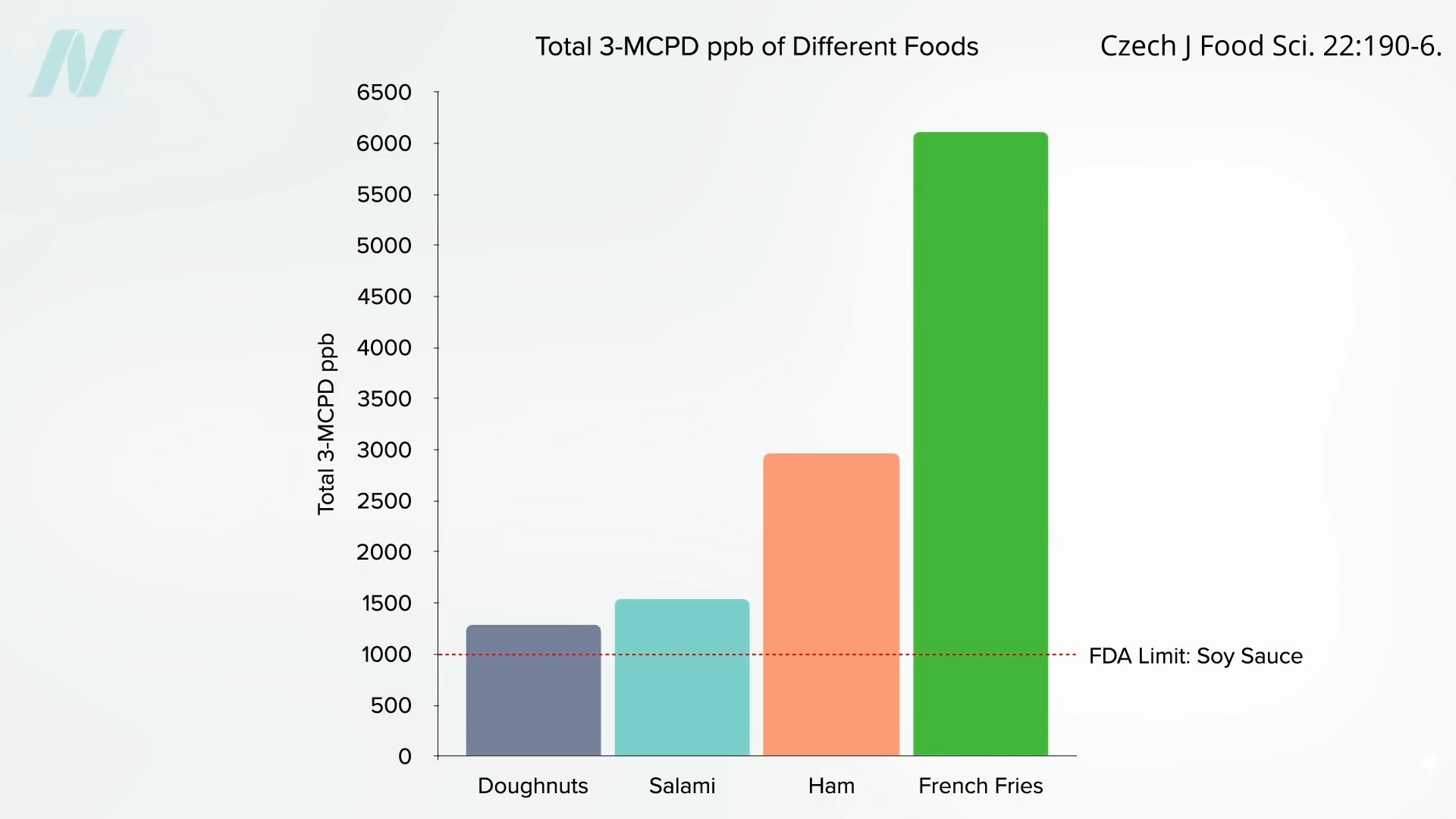
The U.S. Food and Drug Administration’s limit for soy sauce is 1,000 ppb, but donuts can have more than 1,200 ppb, salami more than 1,500 ppb, ham nearly 3,000 ppb, and French fries in excess of 6,000 ppb, as seen here and at 4:03 in my video The Side Effects of 3-MCPD in Bragg’s Liquid Aminos.

Most of us don’t have to worry about this problem, unless we’re consumers of fried food. Someone weighing about 150 pounds, for example, who eats 116 grams of donuts, would exceed the European Food Safety Authority’s TDI, even if those donuts were the person’s only source of exposure. That’s about two donuts, but the same limit-blowing amount of 3-MCPD could be found in only five French fries.

Doctor’s Note

Believe me, I pleaded with the Bragg’s folks over and over. It’s curious to me that Bragg’s allowed me to talk about where its level of 3-MCPD fell compared to the standards but not say the number itself. At least it’s doing third-party testing.

Learn more about this topic in my video 3-MCPD in Refined Cooking Oils.

You can also check out Friday Favorites: The Side Effects of 3-MCPD in Bragg’s Liquid Aminos and Refined Cooking Oils.

from NutritionFacts.org https://nutritionfacts.org/blog/chlorohydrin-3-mcpd-in-braggs-liquid-aminos/
via IFTTT

Treat the Cause

Treat the underlying cause of chronic lifestyle diseases.

It’s been said that more than 2,000 years ago, Hippocrates declared, “Let food be thy medicine and medicine be thy food.” In actuality, it appears that he never actually said those words, but there’s “no doubt about the relevance of food…and its role in health and disease states” in his writings. Regardless, 2,000 years ago, disease was thought to arise from a bad sense of “humors,” as you can see here and at 0:32 in my video Lifestyle and Disease Prevention: Your DNA Is Not Your Destiny.

Now, we have science, and there is “an overwhelming body of clinical and epidemiological evidence illustrating the dramatic impact of a healthy lifestyle on reducing all-cause mortality”—meaning death from all causes put together—“and preventing chronic diseases such as coronary heart disease, stroke, diabetes, and cancer.” But don’t those diseases just run in our family? What if we just have bad genes?

According to the esteemed former chair of nutrition at Harvard, for most of the diseases that have contributed “importantly” to mortality in Western peoples, we’ve long known that non-genetic factors often account for at least 80% to 90% of risk. We know this because rates of the leading killers, like major cancers and cardiovascular diseases, vary up to 100-fold around the world, and, “when groups migrate from low- to high-risk countries, their disease rates almost always change to those of the new environment.” Modifiable behavioral factors have been identified, “including specific aspects of diet, overweight, inactivity, and smoking that account for over 70% of stroke and colon cancer, over 80% of coronary heart disease, and over 90% of adult-onset [type 2] diabetes”—diseases that can largely be prevented by our own actions.

If most of the power is in our own hands, why do we allocate massively more resources to treatment than prevention? And speaking of prevention, “even preventive strategies are heavily biased towards pharmacology rather than supporting improvements in diet and lifestyle that could be more cost-effective. For example, treatment of [high] serum cholesterol with statins alone could cost approximately 30 billion dollars per year in the United States and would have only a modest impact on coronary heart disease incidence. The inherent problem is that most pharmacologic strategies don’t address the underlying causes of ill health in Western countries, which are not drug deficiencies.”

Ironically, the chronic diseases that are most amenable to lifestyle treatment are the same ones most profitably treated by drugs. Why? If you don’t change your diet, you have to pop the pills every day for the rest of your life. So, the cash-cow drugs are the very drugs we need the least. “Even though the most widely accepted, well-established chronic disease practice guidelines uniformly call for lifestyle change as the first line of therapy, physicians often do not follow these recommendations.” “By ignoring the root causes of disease and neglecting to prioritize lifestyle measures for prevention, the medical community is placing people at harm.”

“Traditional medical care relies primarily on the application of pharmacologic and surgical interventions after the development of illness,” whereas lifestyle medicine relies primarily on “the use of optimal nutrition (a whole foods, plant-based diet) and exercise in the prevention, arrest, and reversal of chronic conditions leading to premature disability and death. It looks in a holistic way at the underlying causes of illness.”

Dr. Adriane Fugh-Berman, director of PharmedOut, a wonderful organization I’m proud to support, wrote a great editorial entitled “Doctors Must Not Be Lapdogs to Drug Firms.” “The illusion that the relationship between medicine and the drug industry is collegial, professional, and personal is carefully maintained by the drug industry, which actually views all transactions with physicians in finely calculated financial terms…The drug industry is happy to play the generous and genial uncle until physicians want to discuss subjects that are off limits, such as the benefits of diet or exercise, or the relationship between medicine and pharmaceutical companies…Let us not be a lapdog to Big Pharma. Rather than sitting contentedly in our master’s lap, let us turn around and bite something tender.”

Doctor’s Note

The organization I mentioned, PharmedOut, is a project of Georgetown University Medical Center.

For more on Lifestyle Medicine, see related videos below.

from NutritionFacts.org https://nutritionfacts.org/blog/treat-the-cause/
via IFTTT

robotic surgeon, gynecologic cancer treatment center, holistic oncologist

Design a site like this with WordPress.com
Get started